

Industry Tips
Handling Bad Weather Days Without Wrecking Your Schedule
A storm doesn't just cancel one job, it wrecks the whole day at once. Here's how to reschedule fast without losing the rest of the week untangling it.
Momentum FSM Team
Industry Tips
Managing weekly pool cleaning routes doesn't have to be complicated. Learn how to reduce drive time, organize recurring appointments, balance technician workloads, and keep your pool service business running efficiently.
Running a successful pool cleaning business involves more than keeping swimming pools clean. Between scheduling weekly visits, assigning technicians, managing customer requests, and dealing with unexpected delays, keeping your routes organized can quickly become a challenge.
As your customer list grows, inefficient scheduling can lead to unnecessary driving, missed appointments, frustrated customers, and higher operating costs.
The good news? With the right approach to pool service route planning, you can create more efficient schedules, reduce wasted time, and keep your technicians productive without sacrificing service quality.
Here are seven practical ways to manage weekly pool cleaning routes more efficiently.
One of the easiest ways to improve route efficiency is to organize customers geographically.
When technicians travel back and forth across town between appointments, valuable time is lost behind the wheel instead of servicing pools.
Rather than scheduling appointments based solely on customer preferences or the order in which they were booked, consider grouping customers into designated service areas.
For example, a pool cleaning company serving Cape Coral and Fort Myers might organize its weekly schedule by neighborhood:
Monday: Northwest Cape Coral
Tuesday: Northeast Cape Coral
Wednesday: Southwest Cape Coral
Thursday: Southeast Cape Coral
Friday: Fort Myers and surrounding areas
This approach helps minimize unnecessary travel and creates more predictable daily schedules.
Keep in mind that geographic grouping should also account for technician availability, service requirements, and customer scheduling restrictions.
Pro Tip: Review your existing customer locations before assigning service days. You may discover opportunities to move nearby customers onto the same route.
Most residential pool cleaning customers expect service on a recurring weekly schedule.
Keeping customers on consistent service days benefits both your business and your customers.
For technicians, predictable schedules make it easier to plan routes and prepare equipment and supplies.
For customers, knowing when their pool will be serviced reduces uncertainty and unnecessary calls.
However, manually recreating the same appointments every week can become time-consuming, particularly as your business grows.
Using recurring service scheduling software allows you to establish repeating appointments without rebuilding the schedule each week.
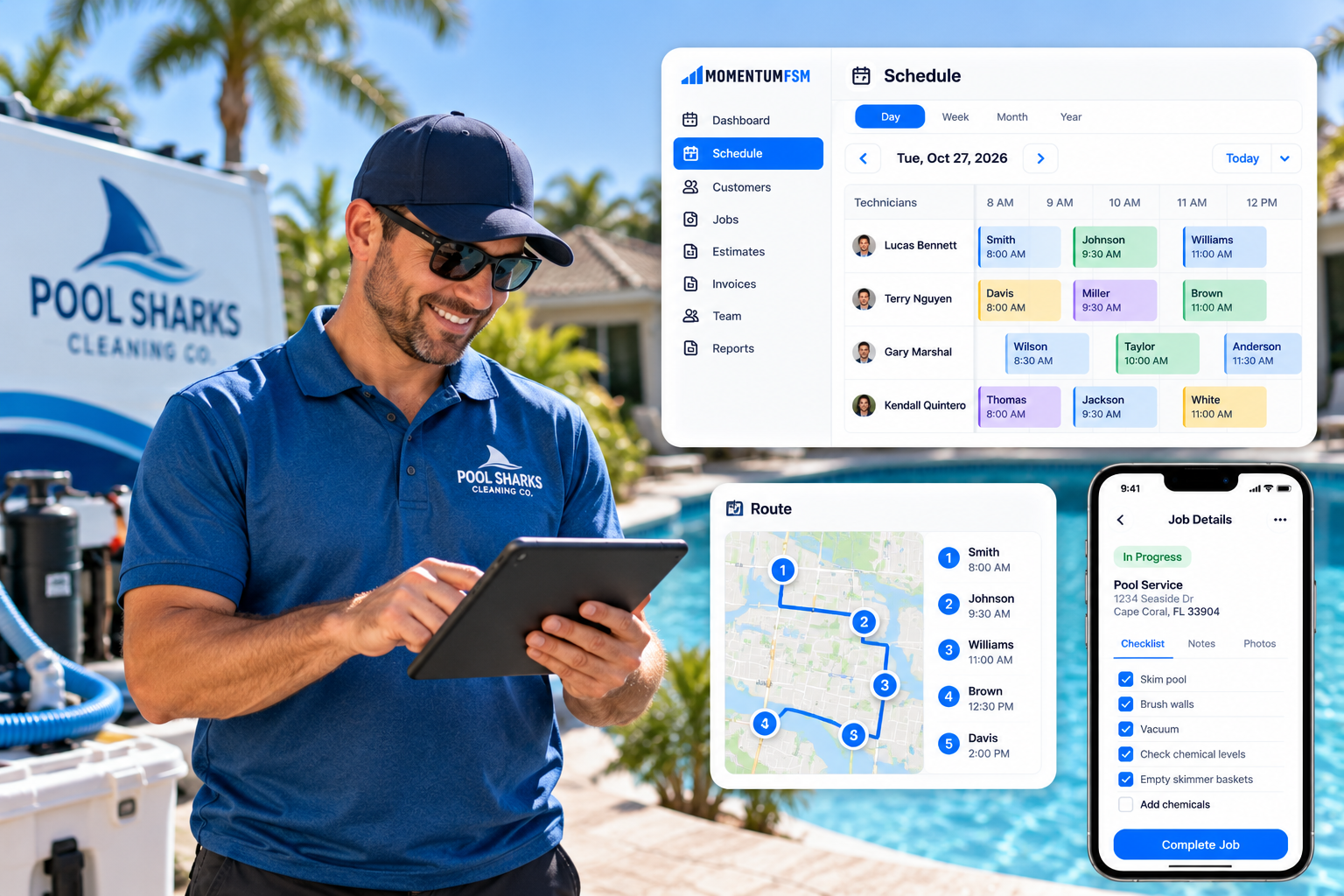
With Momentum FSM, pool service businesses can organize recurring customer visits and manage scheduled work from a centralized calendar.
This makes it easier to maintain consistent service schedules while accommodating changes when necessary.
An efficient route isn't necessarily the one with the most stops.
It's the one that allows technicians to complete their assigned work safely, consistently, and within a reasonable workday.
Consider two technicians:
Technician A
12 scheduled pools
Several stops requiring additional maintenance
Customers spread across multiple neighborhoods
Technician B
9 scheduled pools
Mostly standard weekly cleaning
Customers located close together
Although Technician A has more appointments, their route may be considerably less efficient.
When assigning pool service routes, consider:
Estimated service duration
Driving distance between stops
Pool size and maintenance requirements
Technician experience
Special customer instructions
Available working hours
Balancing these factors helps prevent overloaded schedules and reduces the likelihood of unfinished appointments.
Field service scheduling software can help managers review technician assignments and make adjustments as workloads change.
Not every swimming pool requires the same amount of attention.
A standard weekly cleaning might involve skimming debris, brushing surfaces, checking chemical levels, emptying baskets, and inspecting equipment.
Other visits may require additional work, such as filter cleaning, algae treatment, or equipment troubleshooting.
Scheduling every appointment for the same duration can create unrealistic expectations.
Instead, establish estimated service times based on the work being performed.
For example:
Estimated Pool Service Times
Standard Weekly Pool Cleaning: 30–45 minutes
Pool Cleaning With Additional Maintenance: 45–60 minutes
Filter Cleaning: 30–60 minutes
Equipment Inspection: 30–45 minutes
Green Pool Treatment: 60–120 minutes or more
These are illustrative planning estimates. Actual service times vary based on pool conditions, equipment, and the work required.
Accurate time estimates help managers create realistic schedules and identify how many appointments a technician can reasonably complete each day.
They also make it easier to accommodate additional work without disrupting an entire route.
Efficient pool service routes depend on more than knowing where to drive.
Technicians also need access to important customer information when they arrive.
This may include:
Gate codes and property access instructions
Pool equipment locations
Special cleaning requirements
Customer communication preferences
Previous maintenance notes
Service history
When this information is scattered across text messages, paper notes, or spreadsheets, technicians may waste time contacting the office or searching for instructions.
A centralized customer management system helps keep relevant information organized and accessible.
With Momentum FSM, businesses can maintain customer records, service addresses, appointments, and related service information within one platform.
Having this information available helps technicians prepare for each visit and reduces unnecessary back-and-forth communication.
Even the most carefully planned pool cleaning routes occasionally need adjustments.
Common disruptions include:
Heavy rain or thunderstorms
Technician absences
Equipment problems
Unexpectedly time-consuming service visits
Customer cancellations
Emergency maintenance requests
In Southwest Florida, afternoon thunderstorms can be particularly disruptive during the rainy season.
When several appointments need to be moved, manually updating schedules and notifying customers can quickly become overwhelming.
A centralized scheduling system makes it easier to review affected appointments, adjust technician assignments, and organize the remaining work.
Rather than relying on multiple spreadsheets or handwritten notes, managers can work from a single schedule.
It's also helpful to establish a standard process for weather-related delays, including how customers will be notified and how postponed visits will be prioritized.
Pro Tip: Leave some flexibility in your weekly schedule for unexpected service needs. Filling every available minute can make even a minor disruption difficult to manage.
Pool service routes shouldn't remain unchanged indefinitely.
As your business grows, you may add customers in new neighborhoods, hire additional technicians, or expand into new service areas.
A route that worked well with 30 customers may no longer be efficient when you're servicing 100.
Periodically review your schedules to identify opportunities for improvement.
Ask yourself:
Are technicians spending too much time driving?
Are certain days consistently overloaded?
Could nearby customers be grouped together?
Are service appointments regularly running longer than expected?
Are technicians returning to the same neighborhoods multiple times each week?
Could recurring appointments be reassigned to create more balanced routes?
Even small adjustments can make a meaningful difference over time.
For example, reducing unnecessary travel by just 15 minutes per technician each workday would save approximately 5 hours per week across a team of four technicians.
Over the course of a year, those savings can add up.
Managing weekly pool cleaning routes manually may work when you're just starting out.
But as your customer base expands, spreadsheets, paper calendars, and text messages can become increasingly difficult to maintain.
Field service management software brings scheduling, customer information, technician assignments, and service records together in one place.
With Momentum FSM, pool service businesses can manage important day-to-day operations, including:
Recurring Service Scheduling
Organize weekly pool cleaning appointments and maintain consistent service schedules.
Technician Management
Assign work to technicians and keep scheduled visits organized.
Customer Management
Maintain customer profiles, service addresses, and important account information.
Route Management
Review assigned service stops and organize daily routes.
Mobile Service Checklists
Give technicians a structured way to record completed service tasks while working in the field.
Recurring Contracts and Billing
Manage ongoing customer service agreements and their associated billing arrangements.
By keeping these operations connected, pool service businesses can spend less time managing administrative tasks and more time serving customers.
Efficient pool cleaning routes don't happen by accident.
They require thoughtful scheduling, realistic service times, organized customer information, and the flexibility to adapt when plans change.
Whether you're managing a handful of weekly customers or coordinating multiple pool service technicians, improving your route planning process can help reduce unnecessary travel, improve productivity, and deliver more consistent service.
The goal isn't simply to squeeze more appointments into each day.
It's to build a reliable, repeatable system that allows your business to grow without creating unnecessary scheduling headaches.
Managing recurring pool cleaning appointments, technician schedules, and customer information doesn't have to involve multiple spreadsheets and disconnected tools.
Momentum FSM brings your essential field service operations together in one easy-to-manage platform.
Spend less time organizing schedules and more time growing your pool service business.
Start Your Free Trial
Industry Tips
A storm doesn't just cancel one job, it wrecks the whole day at once. Here's how to reschedule fast without losing the rest of the week untangling it.